Mining EquipmentTyre Handler Attachments for Mining: Applications, Types and Key Considerations
6–7 min read | Vatsav Engineering Private Limited
Large earth-moving tyres are an important part of mining equipment and tyre change operations require equipment that can handle the OTR tyre assembly. A tyre handler attachment provides a dedicated way to handle, align and position OTR tyres while reducing manual effort.
What Is a Tyre Handler Attachment?
Tyre Handler Attachment is a equipment specifically designed and manufacuted to handle tyres of various sizes. In General the tyres used in mining industry are of larger diameters with heavy weights. To handle such large size OTR Tyres which cannot be handled manually this equiment is integrated with prime mover.
Why Application Matters
Tyre dimensions, tyre and rim weight, available prime mover and working space influence the suitable handler. Vatsav has developed four series based on tyre-change requirements and available prime movers.
Why choose VATSAV make Tyre Handler Attachments
Vatsav make tyre handler attachements are designed specifically to suit the mining environment. Vatsav Make Tyre Handler Attachments is approved by "The Patent Office, Government of India" and the company hold the design rights for the V-Series Handler Attachment.Vatsav Engineering's Tyre Handler Attachments are manufactured as detachable components. This allows customers to work with a wheel loader or forklift as the prime mover according to their choice and availability.Vatsav also develops handlers based on specific customer requirements, with standard models up to 12 MT considering tyre and rim weight.
V Series Tyre Handler
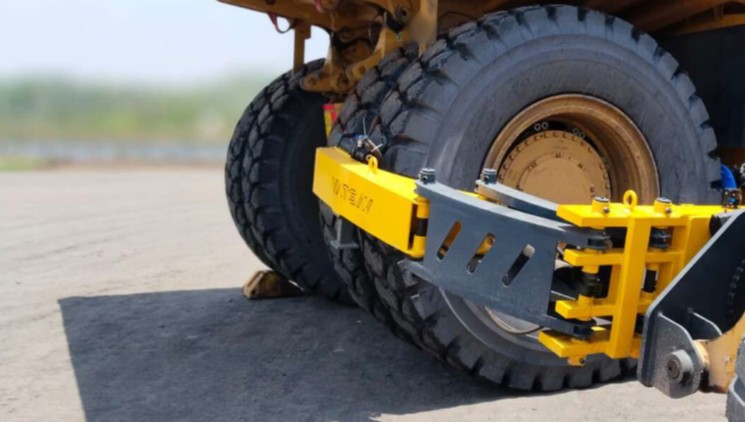
The V Series is designed for tyre changes in open-cast mines and for dumpers ranging from 40 tons to 240 tons. Its curved structure is designed to provide clearance during removal and fitment.
Technical Specification- Clamping Range: up to 4200 mm (customizable)
- Capacity: up to 12 tons (customizable)
- Tyre Rotation: Continuous 360°
- Handler Rotation: ±70° (customizable up to 360°)
- Side Shift: 220 mm (110 mm each side), if required
- Local content: 100% Made in India
A Series Tyre Handler
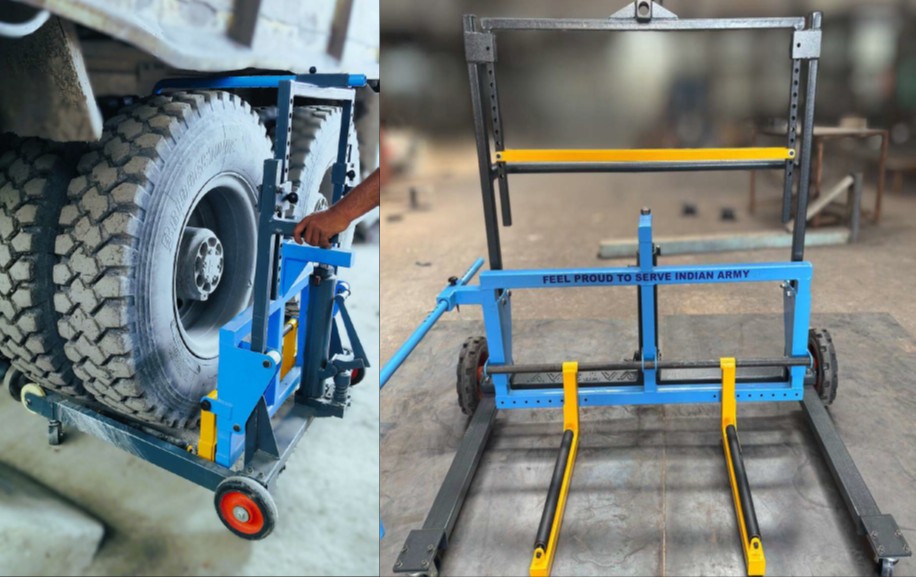
The A Series manual tyre handler is designed for tyre changes on tippers such as Volvo and Scania. It is lightweight and easy to assemble and transfer. Vatsav has also supplied this manual handler for tyre changing on TATRA Trucks to the Indian Army.
Technical Specification- Clamping Range: up to 1500 mm (customizable)
- Capacity: up to 700 kg (customizable)
- Tyre Rotation: Manual 360°
- Lifting: 300 mm from ground
- Lifting Type: Foot-pedal-operated hydraulic cylinder
- Local content: 100% Made in India
T Series Tyre Handler
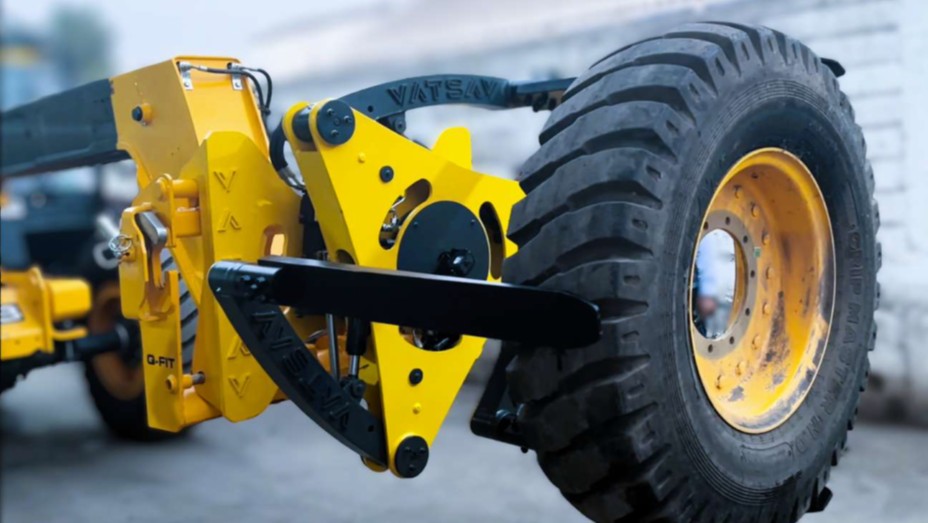
The T Series is designed specifically for changing tyres in constrained areas where the distance between the mudguard and tyre is less. It is intended for dumper and loader tyres up to 1800 kg, with a three-point contact design.
Technical Specification- Clamping Range: up to 2200 mm (customizable)
- Capacity: up to 1.8 tons (customizable)
- Tyre Rotation: Continuous 360°
- Tilting: 110°, if required
- Side Shift: 220 mm (110 mm each side), if required
- Local content: 100% Made in India
S Series Tyre Handler
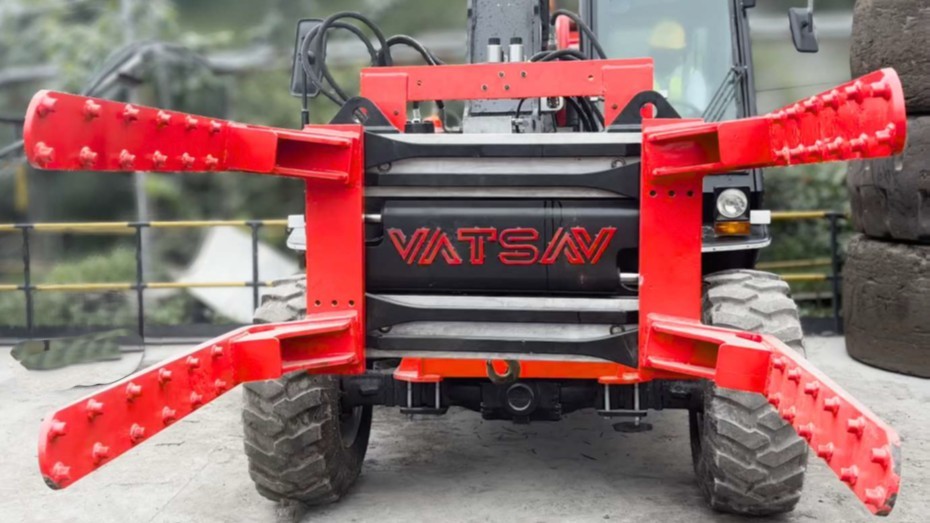
The S Series is designed for tyre changes in underground mines, particularly underground mining dumpers and loaders. It is intended for tyres up to 2300 kg and is designed to provide gripping force on OTR tyres while helping prevent slippage during transport, stacking and tyre change.
Technical Specification- Clamping Range: up to 2300 mm (customizable)
- Capacity: up to 2.3 tons (customizable)
- Tyre Rotation: Continuous 360°
- Tilting: 110°, if required
- Side Shift: 220 mm (110 mm each side), if required
- Local content: 100% Made in India
Detachable Design and Quick Fix Couplers
The detachable design allows the same loaders to be used for other intended purposes. Quick Fix Couplers make interchangeability easier. Existing wheel loaders at a site can also be fitted where requirements are met. Vatsav also highlights user-friendly driver-panel controls and a design that does not use slings or belts.
Choosing the Right Tyre Handler
- Tyre dimensions determine required clamping range.
- Tyre and rim weight determine the required capacity.
- Prime mover affects attachment selection.
- Working space distinguishes open, constrained and underground applications.
- Required movement may include rotation, tilting and side shift.
Conclusion
Tyre handling requirements vary between mining sites and equipment. Vatsav Engineering provides Four (4) tyre-handler series and customized solutions based on customer requirements.
Mining EquipmentCable Reel Handlers for Mining Cable Handling Applications
4–5 min read | Vatsav Engineering Private Limited
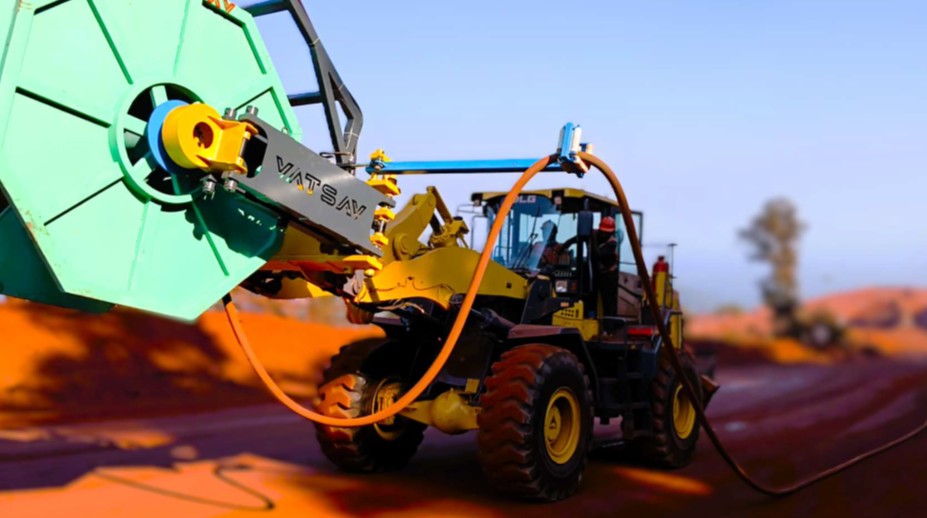
Cable handling can be a demanding part of mining operations, particularly when laying and reeling long lengths of LT and HT cable. A dedicated cable reel handler can provide a mechanical solution for handling the reel and carrying out cable-laying operations.
What Is a Cable Reel Handler?
Vatsav Engineering's Cable Reel Handler is designed specifically for laying LT and HT cables, considering green-mining requirements in India.
Reducing Manual Effort
The attachment is designed to reduce manual effort while laying and reeling HT and LT cables.
Quick-Hitch Compatibility
The cable reel attachment can be used with a Quick Hitch like Vatsav's other attachments. Vatsav states that it was the first in the Indian mining equipment industry to successfully commission a cable reel handler with a quick hitch.
Key Functions
- Reeling – winding cable onto the reel.
- Unreeling – releasing cable from the reel.
- Laying – handling cable during installation.
Technical Specification- Capacity: up to 600 metres cable
- Max. Cable Size: Ø80 mm cable
- Functions: Reeling / Unreeling / Laying of Cable
- Optional: Camera & Monitor
- Local content: 100% Made in India
Why Application-Specific Cable Handling Matters
Cable dimensions, length, laying requirements and the available prime mover influence the configuration. A dedicated attachment can be developed around the actual cable-handling requirement.
Conclusion
For mining operations involving long LT and HT cables, cable reel handling is an important material-handling requirement. Vatsav Engineering's Cable Reel Handler combines reeling, unreeling and laying functions with a detachable attachment approach and optional camera-and-monitor support.
Industrial AutomationSpecial Purpose Machinery: Developing Equipment Around Industrial Requirements
5–6 min read | Vatsav Engineering Private Limited
Industrial manufacturing processes often have requirements that cannot be fully addressed by standard, off-the-shelf machinery. Different components, processes, operating conditions and production targets may require equipment designed specifically for the application.
What Is Special Purpose Machinery?
Special Purpose Machinery (SPM) is equipment developed to perform a defined industrial operation or sequence of operations. The machine is developed around the intended application and its requirements.
Why Requirement Understanding Matters
Every manufacturing process has its own requirements. Component size or geometry, production sequence, available floor space, material flow and integration with existing equipment can influence the machine design.
From Requirement to Machine
- Understand the requirement: identify the operation, component, sequence and constraints.
- Develop the concept: create an engineering concept around the requirement.
- Customer review: review the proposed concept before further development.
- Detailed engineering: develop the required mechanical and automation functions.
- Manufacturing and assembly: manufacture, assemble and integrate the equipment.
- Control and automation: incorporate appropriate control systems where required.
The Role of Automation
SPMs can combine mechanical systems with electrical and software controls. Depending on the application, automation can coordinate machine movements, component handling, operating sequences, sensors, actuators and operator controls.
Integration With Material Handling
A machine does not always operate independently. Components may need to be transferred between operations, so conveyors, material handling equipment, accumulation sections and turning mechanisms can form part of an integrated solution where required.
Vatsav Engineering's Automation Portfolio
- Special Purpose Machinery
- Conveyors
- Material Handling Equipment
- Workholding Devices
- Cutting Tools
Customized Control Systems
Depending on the application, a machine can incorporate PLCs, operator panels, electrical control cabinets, sensors and motor controls. Control software and machine sequence can be developed around the intended operation.
Conclusion
Special Purpose Machinery provides an approach for industrial processes that require equipment developed around a particular application. Starting with the requirement allows mechanical, material-handling and automation considerations to be addressed together.
Material HandlingIndustrial Conveyors: Designing Material Handling Systems Around the Application
5–6 min read | Vatsav Engineering Private Limited
Moving components and materials efficiently between different stages of an industrial process is an important part of manufacturing. Conveyor systems provide a structured way to move materials through a production environment, but the system needs to be designed around the material, production process, movement requirements, layout and automation involved.
What Is an Industrial Conveyor System?
An industrial conveyor system transports materials or components between different points in an industrial environment. Depending on the application, systems can use belt conveyors, chain conveyors, roller conveyors, accumulation sections, turning devices, rotary platforms and guides or transfer mechanisms.
Why Conveyor Design Depends on the Application
Materials vary in size, weight, shape, surface characteristics and orientation. The production environment may require straight transportation, accumulation, turning or controlled positioning. Conveyor systems therefore need to be considered as part of the overall production process.
Accumulation and Flow Management
Different operations may not always operate at the same rate. An accumulation section can provide an area where components temporarily collect before moving to the next stage, helping manage material flow.
Turning Devices and Rotary Platforms
Some processes require components to change direction or orientation. Turning devices and rotary platforms can be incorporated where components need to be rotated, reoriented, transferred or positioned for the next operation.
Conveyor Automation
Modern conveyor systems can incorporate automation to control movement and sequence. Vatsav Engineering develops conveyor automation systems using electrical control cabinets. Depending on the application, the control system can incorporate PLCs, operator panels, motorized switches and main electrical controls.
Customized Control Software
Different production lines can require different control sequences. Control software can be customized according to the conveying line and customer requirements. An operator panel can provide system control and can support recipe-based operation where required.
Energy-Saving Considerations
Energy consumption is an important consideration in industrial equipment. Vatsav Engineering's conveyor automation systems incorporate energy-saving logic intended to minimize plant consumption, with the control strategy developed around the operating requirements of the conveyor line.
Designing the Right Conveyor
- Material: type of material or component.
- Dimensions and weight: size and weight characteristics.
- Movement: straight movement, turning, accumulation or rotation.
- Production process: source and destination of the material.
- Integration: interaction with machines, workstations or handling systems.
- Automation: required level of control.
Vatsav Engineering's Material Handling Solutions
Vatsav Engineering's automation portfolio includes Special Purpose Machinery, Conveyors, Material Handling Equipment, Workholding Devices and Cutting Tools. Conveyor and material-handling solutions can be developed around the requirements of the intended application.
Beyond Conveyors
Handling → Conveying → Accumulation → Turning → Positioning → Processing
Conclusion
An industrial conveyor system should be designed around the material and process it supports. Material characteristics, movement, accumulation, turning, positioning, automation and integration can all influence the final design.
Have an Engineering Requirement?
Talk to Vatsav Engineering about your mining, automation or material-handling application.
Contact Vatsav Engineering
 Designed by FlashMa Technology